
07/07/2026
Regional service trains will now run on electric power between Lagos and Vila Real de Santo António.
The railway infrastructure certification process has been successfully completed. There is an 18% increase in regional services and more frequent services during peak hours.
CP – Comboios de Portugal and Infraestruturas de Portugal (IP) have announced that, from 19 July, the entire Algarve Line will be electrified, enabling electric trains to run between Lagos and Vila Real de Santo António. This change represents a significant improvement in service levels, with shorter journey times, increased service frequency, and the promotion of a more sustainable mode of transport.
This development follows the completion of the certification process for the Algarve line’s overhead cables, which IP installed and electrified as part of the works it carried out to improve safety standards, railway operations and the modernisation of the railway infrastructure serving the Algarve region.
The start of electric traction operations on the Algarve Line represents an improvement in operational levels, service provision, and the sustainability of rail transport, and constitutes an investment with a direct impact on the daily mobility of local residents and the region’s main economic activity, tourism. The new service boosts connections between the main towns in the Algarve and improves links with long-distance services to Lisbon and the north of the country.
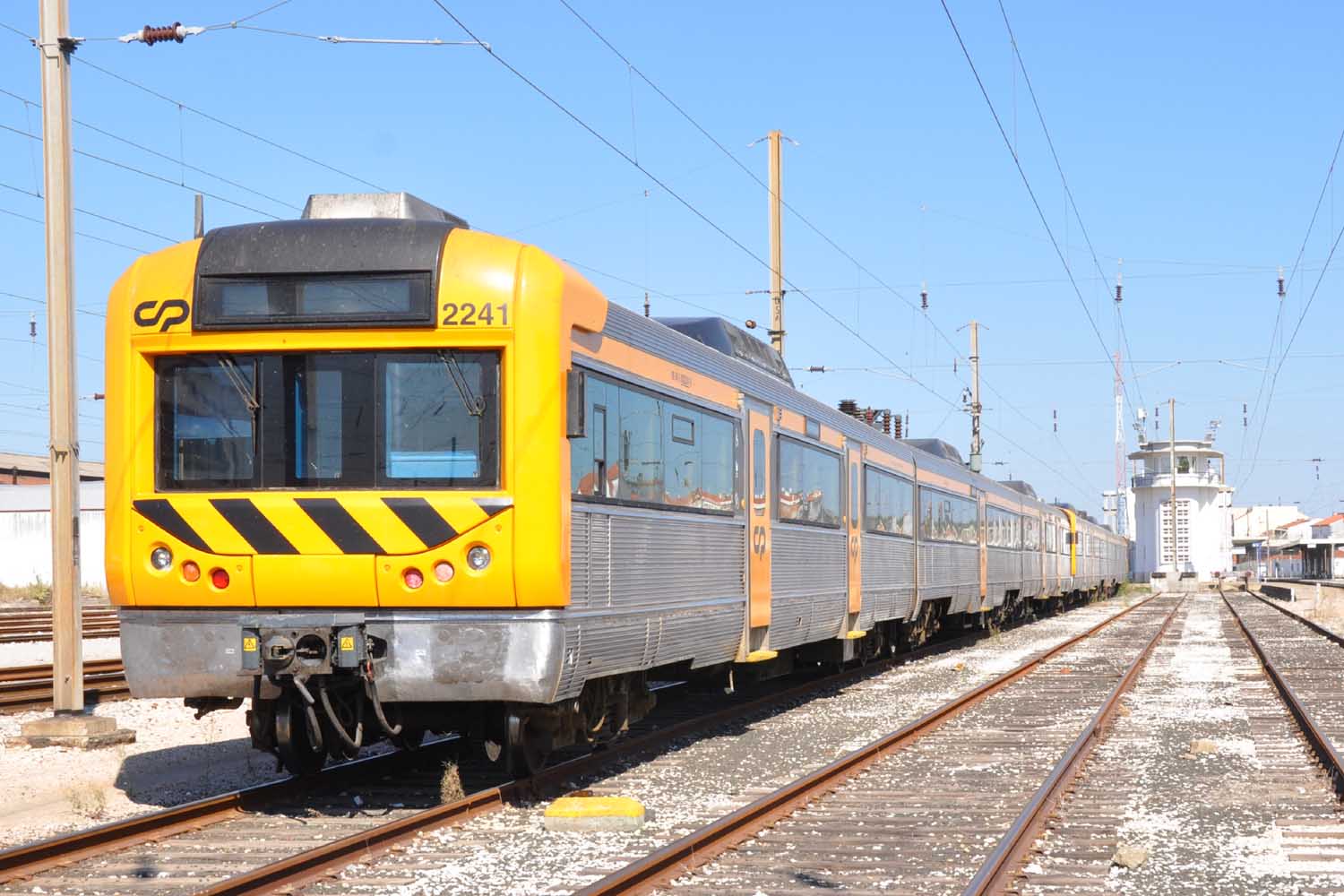
From this date onwards, CP will implement a new service model on the Algarve Line. CP will replace the current diesel trains (UDD450) with electric trains – the UTE 2240 – which are more efficient, more comfortable, and more sustainable, enabling a significant increase in capacity and the quality of the service provided. In addition, there will be an 18% increase in regional services and greater frequency during peak hours, making the journey faster thanks to the introduction of direct trains between Vila Real de Santo António and Lagos, which allows travellers to complete their journeys without changing trains at Faro.
The electric trains offer around 40% more seats than the current rolling stock, increasing capacity from 388 seats (164 seated and 224 standing) to 536 seats (264 seated and 272 standing). They also offer greater comfort through reduced noise levels, improved accessibility, including electric lifting platforms and space for wheelchairs, and passenger information systems (visual and audible). The full transition to electric traction enables improvements in operational and environmental efficiency, as eliminating diesel refuelling reduces pollutant emissions and supports national decarbonisation targets for the transport sector.
With electrification, there will now be direct connections between Vila Real de Santo António and Lagos, reducing the need to change trains in Faro and shortening journey times. An InterRegional service will also be introduced, with two trains a day and fewer stops, enabling faster and more competitive journeys. With the increase in regional services, there will now be a train every hour between Vila Real de Santo António and Faro, and every two hours between Faro and Lagos, with increased frequency during peak hours, thereby better meeting demand.
This investment has a direct impact on the daily mobility of local residents and on tourism, the region’s main economic activity. The new service model enhances the competitiveness of rail transport, helping to reduce journey times on the Regional service along the Algarve coast, strengthening connections between the region’s main cities, and improving long-distance connections between the Algarve and the rest of the country.
About the Algarve line
The Algarve line, which connects Vila Real de Santo António and Lagos, is approximately 141 kilometres long. Its catchment area covers 11 municipalities in the district of Faro (Lagos, Portimão, Lagoa, Silves, Albufeira, Loulé, Faro, Olhão, Tavira, Castro Marim and Vila Real de Santo António), accounting for around 88% of the region’s resident population (436,000 inhabitants, according to provisional data from the 2021 Census).
In recent years, demand for services on this line has grown, both for regional and long-distance travel, driven by commuter traffic and strong tourism growth.


